

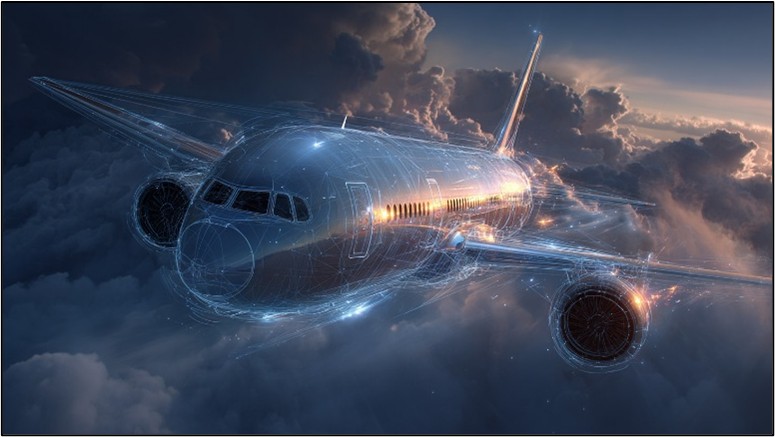
How engineers are making planes that run on batteries and not hydrocarbons
Every modern airplane is built twice.
First on screens. Then in metal.
And that’s not a figure of speech. Airbus put it bluntly: "We're essentially manufacturing each aircraft twice — once in a machine-driven environment and then again in a human-driven one." It sounds simple — create a version on the computer, test it for problems, correct them and then build the real thing. But what really takes place in those digital prototypes? Engineers don't just test designs. They break them. Deliberately. Repeatedly. Thousands of times.
A physical test costs about 100 times as much as a virtual one. So, before they cut a single length of metal, teams run their aircraft through simulated hurricanes, lightning strikes to its body, the impact of birds on its wings and vibrations intended to simulate hard knocks that would really be dangerous to test out with a real airplane.
When something finally takes flight? It has already endured far more abuse than most airplanes will ever see in service.
The Plane That Changed Everything
The Boeing 777 was the watershed moment. It became the world's first 100% digitally designed commercial airplane when introduced in the early 1990s. No full-scale physical mock-up. About 1,700 computer workstations connected to four mainframes. 240 design teams toiling through nearly 1,500 disparate issues — all on screens.
The first time Boeing built a mock-up of the nose section to validate the accuracy of said models, their fit was so perfect that all further mock-ups were scrapped. Floor beams that were supposed to go up in 19 weeks? Done in 3. That factory rework they had planned for? Cut dramatically.
Boeing even invented something it called "CATIA-man" — a computer-represented mechanic who could slither inside the digital airplane and confirm whether those parts really were accessible for maintenance. At one point, this digital human found that a navigation light on the roof of the 777 was not available for bulb changes. A problem that in the real world would have simply resulted in flight delays. Nipped in the bud before one rivet went into place.
Breaking Things on Purpose
Okay. So. What is "virtual testing," exactly?
Structural engineer’s subject components to millions of stress cycles. Not dozens. Not hundreds. Millions. They replicate fatigue, vibration, thermal variations and mechanical loads throughout the length of an aircraft's expected life — and then some.
Aerodynamicists perform computer simulations of the airflow at hundreds or thousands of flight conditions, using computational fluid dynamics. Extreme angles. Icing. Crosswinds. Conditions and situations that would be unsafe or unfeasible to evaluate in the real world.
Systems engineers examine the way electrical, hydraulic and avionics systems come together — in search of collisions between what could total some millions of individual parts.
Boeing's Systems Lab can, in five weeks, simulate 45 years of flying. They practically age airplanes to see how software, fuel systems and controls will respond for decades to come.
This isn't replacing physical testing. Physical tests still happen. The 787 Dreamliner underwent fatigue testing that simulated 165,000 flight cycles — 3.75 times its design service life — with wings flexed 25 feet upward. The 777 endured 120,000 simulated flights using 100 hydraulic actuators.
But those physical tests come after countless digital iterations. By that point, engineers already know what is supposed to happen. They're confirming, not discovering.
30 Minutes to Change a Whole Industry
The T-7A Red Hawk may be the most dramatic evidence so far of what digital-first design can accomplish.
This Air Force trainer jet, from a standing start, went from development to first flight in 36 months. Most such programs are five to seven years long. Assembly hours dropped 80%. First-time engineering quality improved 75%. Time for software development was reduced by 50 percent.
But the point that had engineers gasping? The fore and aft sections of fuselage were constructed 4,500 miles apart — Boeing in St. Louis, at Lambert International Field; Saab was working on the production line for Sweden's version at Linköping. Different facilities. Different countries. Different continents.
They were married in less than 30 minutes.
That was what digital design allowed. Production director Andrew Stark reported a 50% increase in manufacturing quality overall and up to 98% reduction in drilling defects. The T-7A Red Hawk became active in the Air Force in January 2026.
The Digital Native Bomber
Then there is Northrop Grumman's B-21 Raider, which pushes the idea further. They call it a "true digital native" — built from the ground up with what they're calling "Model-Based Everything."
Aerodynamic performance. Stealth characteristics. Structural loads. Systems integration. All in simulation before physical parts went into production. Design changes that would have taken months to evaluate in person? Validated in hours.
For the program, Northrop put more than $2 billion into digital infrastructure. Result: double the industry standard accuracy for predicting ground test results. Software certification time cut 50% compared to the F-35. Manufacturing hours were cut by about a third in some areas.
Test pilot Chris "Hoss" Moss reported after the initial flight: "The handling qualities are better than expected coming out of the simulated environment."
Better than expected. From a simulation. That's not supposed to happen.
Engines That Exist in Two Worlds
And engine makers have probably taken digital twins to the most advanced application. Rolls-Royce's IntelligentEngine initiative crafts a digital twin of each engine it produces. More than 13,000 engines in operation are tracked around the world, with sensors and satellite links continuously feeding back data.
The findings: time between maintenance was stretched as much as 50 percent for some engines. One airline has saved 85 million kilograms of fuel and more than 200 million kilograms of CO₂ from the atmosphere since 2014. The company estimates 22 million tons of carbon have been saved through data-driven guidance.
Rolls-Royce CIO Stuart Hughes describes the philosophy: "We're designing our maintenance regimes to ensure that we are operating for the life an engine has, not what the manual says it should have."
GE Aerospace already constructed a digital twin for each of the GE and CFM engines in operation, that huge GE9X included. And GE built more than 1.2 million digital twins in its businesses between 2016 and 2017 alone.
What Comes After the Screen
Wind tunnels still exist. Physical tests still matter. The U.S. has about 60 wind tunnels right now, down from 120 in 1985; computational fluid dynamics had produced a roughly half reduction in the number of hours of wind tunnel testing needed for designs. But digital simulation takes 20-30 possibilities and winnows them to 2-3 for physical testing. It's not getting rid of validation — it is making such validation orders of magnitude more efficient.
Skywise developed by Airbus is now in operation for 12,000+ aircraft and over 50,000 users worldwide. Each delivered aircraft also has its own digital twin, constantly fed with real-time data from sensors for predictive maintenance.
In December 2025, the Perseverance rover from NASA completed an autonomous 456-meter drive on Mars — orders that were tested against a digital twin which confirmed that more than half a million telemetry variables checked out before transmission. The first NASA dynamic digital twin launched into space in February 2026, and has returned real-time health data on the satellite system.
The pattern holds across programs: freedom to fail virtually produces better outcomes in reality.
An engineer who cracks a wing spar in simulation and a student who blows up a chemistry experiment in a virtual lab are engaged in the same basic activity — learning through iteration, without fear of catastrophic failure. The digital world is no replacement for reality. It's the practice that makes reality work.
By the time something takes off, it has been shattered and rebuilt thousands of times.
That's the point.
THE ECONOMICS
A physical test is about 100 times more expensive than a virtual one. Digital-first design doesn't do away with physical testing — it optimizes each one of those costly trials.
THE PROOF POINTS
→ Boeing 777: World's first fully digitally designed commercial aircraft
→ T-7A Red Hawk: 36 months to first flight, 80% assembly reduction
→ B-21 Raider: $2B digital investment, 50% faster software certification
THE LIVING TWINS
Rolls-Royce is monitoring more than 13,000 engines in real time. GE created more than 1.2 million digital twins. Airbus Skywise connects 12,000+ aircraft. The digital version coexists with the physical edition.
THE BOTTOM LINE
Break it on the screen. Fix it on the screen. By the time it takes flight, it's already survived everything.
Mentis Sciences operates at the frontier of the possible — advanced composites, hypersonic materials, aerospace engineering, defense tech. The problems you have to get it right about. www.mentissciences.com
