

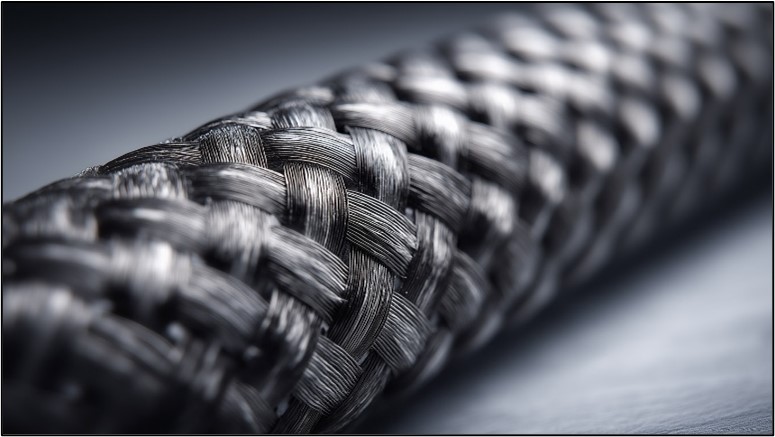
Consider a crack moving through a material.
In traditional composites, the kind designed around layers placed next to one another, like sheets stacked up on a table, that crack has an easy route. It glides between layers, like a letter opener through an envelope. The technical term is delamination.
The actual outcome can be structural failure.
Now imagine the same crack trying to propagate through a braided composite.
It strikes a fiber going in one direction. Stops. Tries another path. Gets a fiber on the other end. Stops again. The interlocking structure forces damage to run through a maze without any clear exit. The energy that could have blown through a laminated structure dissipates, spreads out, is contained.
That’s the braided composite advantage. And it’s redefining what’s possible in aerospace engineering.
The Problem with Layers
Traditional laminated composites revolutionized aerospace. They provided strength-to-weight ratios that metals couldn’t even approach. They made modern aircraft possible.
But they have a core weakness.
Laminated composites are basically piles of two-dimensional materials attempting to work in a three dimensional stress environment. They are very good in-plane — within layers. But between layers? That’s where problems develop. Impact damage, fatigue, thermal cycling — all can work to pry layers from one another. Delamination, when it occurs, spreads.
Numerous solutions have been developed by the aerospace industry. Stitching. Z-pinning. Toughened resins. Each helps. None of them addresses the underlying architecture.
Braiding gives the engineers and designers a way to efficiently create different fiber architectures that that behave far better under certain loading scenarios that traditional composites.
What Braiding Actually Does
Braiding technology started humble. Shoelaces. Ropes. Decorative trim. The fundamental principle is familiar from ancient times: interweave fibers so they attach to one another, and hold together, without glue or fasteners.
In industrial braiding machines, the principle is similar and it is applied using high-performance fibers such as carbon, aramid or glass. Spools rotate around a central mandrel and apply fibers into interlocked two or three-dimensional architectures. Some machines can place more than a hundred fibers at once, which allows sophisticated formations to be produced in less time than hand layups would take.
The outcome can be totally unique from laminated composites. In Two-step braiding fibers are oriented in all three axes, interlocking with each other. The result is there are no distinct layers to break apart.
Fibers can be separated and arranged, with the angle between fibers and the axis of a structure — the braiding angle — controlled to a very precise degree. Typically angled between 15 and 75 degrees, the precise angle can be altered to accommodate the anticipated loading of the structure and different braiding methods align with different applications: two-dimensional braids for straightforward geometries, and three-dimensional braids for the highest damage tolerance in multiple planes.
The Damage Tolerance Difference
This is where braided composites truly excel.
In investigating the impact loading, comparison of braided structures versus traditional laminates reported a similar trend. In laminated composites, fibers and matrix fail somewhat independently — once damage starts it can spread deeply. Fiber and matrix act as an integrated system in braided structures. They fail progressively, sucking up energy slowly rather than in a bracing burst.
The particular undulations of the braided form are critical. Macro fractures have no defined pathway to propagate through the matrix. Their propagation is halted at intersections of the yarns. Higher fracture toughness. Better structural stability and better damage tolerance over other pre-preg and laminated options under certain conditions.
Tree-dimensional braided composites have demonstrated that the out-of-plane properties significantly increase as the two step architecture is used. The more directions the fibers are oriented, the more difficult it becomes for damage to find a pathway through the structure.
Strength-to-Weight at Scale
Braided composites would still be very attractive just based on damage tolerance. But there’s more.
High stiffness-to-weight ratios. High strength-to-weight ratios. All of the benefits that made composites critical to aerospace, without risking delamination.
Manufacturing advantages compound the benefits. Complex geometries that traditional composites would entail multiple parts and extensive labor can frequently be braided as monolithic structures. Containment cases for aircraft engines — essential safety structures intended to contain blade failures — have been converted from multi-part assemblies that required a number of fasteners into single-piece braided structures.
This ability to produce variable geometries at an inexpensive cost allows for applications that wouldn’t be practical otherwise. Curved fuselage frames. Wing stiffening elements. Window belt structures. Wherever flexibility and damage tolerance is a must.
Hybrid Possibilities
The braided architecture creates microstructures that would not be possible to build with a single material.
Carbon fiber for stiffness. Aramid fiber for impact resistance. Ceramic fiber for heat tolerance. Single structure cells can be composed of different fibers in certain regions within the same structure, allowing engineers to optimize local properties while preserving an integrated construction.
Highly expansive work focused on hybrid braided composites — carbon and aramid fibers arranged in three-dimensional five-directional patternings — has also yielded impressive results. The composites exhibited the best impact-resistance due to synergistic effect in which aramid fiber acts as axial yarn and carbon fiber as braiding yarn. They also help retain integrity after impacts that would generate damage in pure carbon structures.
Matrix materials are evolving too. Conventional aerospace composites generally involve thermoset resins that fully cure irreversibly. Braided architectures gel especially well with thermoplastic matrices — materials that can be melted and remolded. This allows for benefits regarding processing, impact resistance and recyclability that previous approaches did not provide.
Seeing Inside the Structure
One difficulty with braided composites has been knowing precisely how damage initiates and propagates. That complex three-dimensional architecture that makes them damage-tolerant also makes them difficult to analyze.
This has started to change with recent advances in imaging. Researchers now can observe damage development under load inside braided composite tubes using real-time X-ray computed tomography. They can see exactly where cracks start, how they spread and what halts them.
This type of data turns design from an empirical art into a predictive science. Engineers can precisely customize braided structures for specific service requirements and be assured of how the material will react under a range of conditions.
Advanced imaging gives insight that’s helping to drive adoption. Once a specialized manufacturing technique, braiding is becoming a mainstream option in demanding aerospace applications.
Where Braiding Goes Next
The applications keep expanding.
Aerospace and automotive drive shafts. Athletic equipment where impact resistance is important — hockey sticks and pads, for example. Energy sector components that must endure extreme environments. Medical devices that require biocompatible materials with specific mechanical properties.
Robotics and advanced industrial systems have launched braiding technology out of the textile industry into high-value manufacturing. What began as shoelaces today helps keep aircraft in the air.
The underlying benefit is the same as it ever was. Interlocked fibers. No clear path for damage. Energy that is absorbed and spread out, not focused.
Sometimes the highest-tech solutions to engineering challenges are just like weaving.
THE CORE ADVANTAGE
Delamination cracks propagate between laminate layers in composite materials. Cracks in braided structures hit fibers oriented in multiple directions and can’t find a clear path to move through.
WHAT BRAIDING DELIVERS
→ Improved fracture toughness vs laminated alternatives
→ Significantly greater damage tolerance to impact
→ Single integrated structures with complex geometries
THE HYBRID OPTION
Carbon for stiffness. Aramid for impact. Ceramic for heat. Different fibers in certain segments are tuned to improve local properties while still allowing continuous combined construction.
THE BOTTOM LINE
Locking fibers cut damage off at the pass. It began with shoelaces, and today it keeps aircraft in the sky.
With advanced braiding systems, Mentis Sciences can interface up to 144 fibers at a time, which allows composite performance to be customized for the toughest aerospace and defense applications. www.mentissciences.com
