

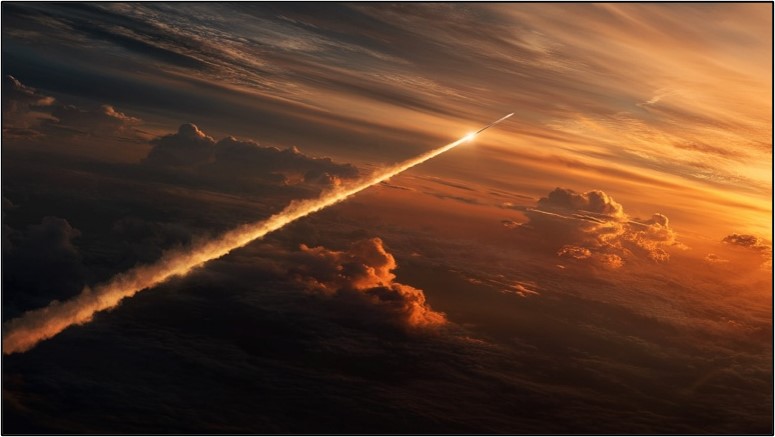
It was scary to break the sound barrier. Engineers reasoned the shockwaves would rip an airplane to shreds. They were wrong, obviously. Chuck Yeager made the X-1 go past Mach 1 in 1947, and supersonic flight eventually became so routine that the Concorde shuttled passengers over the Atlantic for 27 years.
Mach 5 is a whole other animal.
But at five times the speed of sound, about 3,800 miles per hour, the game gets different. Not a little. Completely. The air ahead of the vehicle is compressed so violently that it heats to more than 1,300°C at the nose. That’s hot enough to melt most metals. At Mach 7, the temperatures reach approximately 2,500°C. Above Mach 8, the air actually begins to separate. Oxygen and nitrogen molecules shred into free atoms, creating a plasma sheath around the vehicle that disrupts radio signals and GPS.
Supersonic flight is an engineering challenge. Hypersonic flight is an argument in physics that no one has entirely won yet.
Heat Is the One Antagonist That Destroys Everything
At supersonic speeds, aerodynamic forces drive the design. At hypersonic speeds, heat reigns supreme. And the heating doesn’t scale in a way most people think it does. It scales approximately with the cube of velocity. Double the speed and the heating goes up roughly eightfold. Not twice. Eight times.
The numbers get absurd quickly. At Mach 5, heat fluxes on the vehicle surface can be three to seven orders of magnitude compared to that of solar radiation. Thermal gradients over a leading edge can go from minus 170°C to 3,000°C across an approximately one-centimeter distance. That sort of thermal stress is more than a strain on materials. It shatters them.
And here’s the part that keeps hypersonic engineers up at night: boundary layer transition. The thin layer of air next to the vehicle skin starts out as laminar flow, moving smoothly. Eventually, it becomes turbulent. At that point, heating rates soar. At hypersonic speeds, exactly where and when that transition will happen is one of the least well understood problems in the field. Models exist. They’re imperfect. And when they’re incorrect, vehicles burn.
Materials for Conditions That Shouldn’t Exist
In search of materials that survive hypersonic flight, one truth is clear: No single material does everything well. Each option has a cost-benefit relationship. Every one.
Carbon-carbon composites, carbon fibers bound in a carbon matrix, keep their structural strength above 2,000°F and are used for nose caps and leading edges. They’re tough. But subject them to oxygen at any temperature above roughly 500°C without a protective layer, and they oxidize in short order. They basically disintegrate. That is why they require coatings of silicon carbide, hafnium diboride or zirconium diboride to endure. Those coatings do add complexity, get expensive, and can crack or spall under the same thermal stresses they’re designed to protect against.
Ceramics with ultra-high temperature properties go even further. Zirconium diboride and hafnium diboride melt above 3,000°C; hafnium carbide has a melting point that is among the highest of any known material in science at about 3,958°C. NASA conducted testing of UHTC nosecones under its SHARP-B program through actual reentry conditions. The hafnium diboride/silicon carbide nosecone withstood temperatures above 2,815°C. However, during the SHARP-B2 test, strake segments cracked after only 14 to 19 seconds of reentry due to large grain sizes in the ceramic. Tough material, but can be fragile if the microstructure isn’t strictly controlled..
Ablative materials, such as carbon-phenolic composites, operate on an entirely different principle. Rather than fighting heat, they absorb it via decomposition. The material chars, melts and vaporizes, taking heat away from the underlying structure. The problem? They’re single-use. And when the substance burns away, it’s over. That’s fine if you’re a missile that gets to fly only once. For a reusable vehicle, it’s the end of the road.
The perfect material is heat-tolerant, oxidation-resistant, maintains its strength and offers little weight. It doesn’t exist yet. Every hypersonic vehicle in the air today employs a compromise. Usually several compromises bolted together.
The Nil-Parts Engine
On paper, a scramjet is the simplest engine ever devised. No turbines. No compressors. No moving parts at all. Air goes in one end, gets compressed by the speed of the vehicle, mixes with fuel, burns and exits out the back as thrust.
In practice, doing that is borderline absurd.
Air through a scramjet flows supersonic the whole time. Fuel must be injected, mixed with supersonic air and burned in milliseconds. Not seconds. Milliseconds. The air spends less than the blink of an eye inside the engine. To fully mix fuel and air in that timeframe, they need cavity flame holders, strut injectors and controlled recirculation zones that will keep a flame going while supersonic air blows over it trying to extinguish it.
And scramjets also can’t launch from a standstill. They have to already be flying at about Mach 4 or 5 before they’ll function at all. The X-51A Waverider, arguably the most successful scramjet test vehicle in history, used a solid rocket booster to reach about Mach 4.8 before its scramjet ignited. The fuel, JP-7, also pulls double duty. It burns for thrust and also flows through the engine walls as a coolant, because internal combustion temperatures are above 2,000°C and uncooled engine walls would simply fail.
There were four X-51A flights during the nine-year, $300 million program. Two flights succeeded. The May 2013 test attained speeds of Mach 5.1 and included powered scramjet flight for 210 seconds over more than 230 nautical miles, a record for the longest air-breathing hypersonic flight ever. One inlet unstart and one fin structural failure resulted in two failed flights.
Two successes out of four. For $300 million. That’s where scramjet engineering stands as of now. It works. Sometimes.
No One Can Do Proper Tests of This Stuff
Here’s a conundrum that’s not talked about enough: There is no wind tunnel on Earth capable of fully replicating the conditions of hypersonic flight.
That’s because hypersonic testing means simultaneously matching speed, temperature, pressure and chemistry. Real facilities can replicate some of that, but never all at once, and not for very long. At the Arnold Engineering Development Complex’s Tunnel 9 in White Oak, Maryland, speeds of Mach 7 to 16.5 can be achieved, but only for up to 15 seconds at a time. Simulating actual flight at 5.5 kilometers per second at 45 kilometers altitude would need tunnel temperatures of approximately 9,000 Kelvin and pressures of 3 gigapascals. No facility anywhere on Earth can do that.
The Pentagon’s Director of Operational Test and Evaluation has called the deficiencies in test facilities the number one issue facing U.S. hypersonic programs. Over 70 active programs are vying for extremely limited range and tunnel access. Computational fluid dynamics covers some of this gap, but it is incredibly hard to validate the simulations against real flight data when there is hardly any real flight data.
Where the Programs Actually Stand
DARPA’s HAWC program achieved four consecutive successful flights from 2021 through early 2023. Both competing designs from Raytheon/Northrop Grumman and Lockheed Martin/Aerojet Rocketdyne demonstrated free flight above Mach 5 at over 60,000 feet and in excess of 300 nautical miles. The Air Force described it as the most successful hypersonic airbreathing test program ever conducted in the United States. The follow-on Hypersonic Attack Cruise Missile program is pulling data directly from HAWC.
The Army’s Dark Eagle, a boost-glide weapon carrying a hypersonic glide body at approximately Mach 17 over about 1,725 miles, conducted successful end-to-end tests in June 2024, December 2024 and March 2026. The first battery fielded at Joint Base Lewis-McChord in December 2025. But the program has blown through several deadlines, and as of early 2025 the Pentagon’s testing office had not received sufficient data to assess operational effectiveness.
China’s DF-ZF hypersonic glide vehicle, delivered via the DF-17 missile, underwent at least seven flight tests between 2014 and 2016 and achieved reported speeds of Mach 5 to Mach 10 before entering operational service around 2019. Russia’s Avangard glide vehicle came into service in December 2019, while the Kinzhal air-launched missile became the first hypersonic weapon used in live combat during the conflict with Ukraine.
The race is real. And it’s accelerating.
Why Each Solution Causes Another Problem
That’s the brutal fact of hypersonic engineering. Solve the heating issue with ablative materials, and you can’t reuse the vehicle. Solve the reusability issue with ceramics, and they fail under thermal stress. Use carbon-carbon to tackle thermal shock, and oxidation degrades the surface. Coat the surface, and the coating spalls. If you make a scramjet that flies, it can’t start by itself. Add a rocket to get up to scramjet speed, and the system gets heavier and more complicated.
Each reply begets a fresh query. Every solution adds a constraint. That’s not evidence that hypersonic engineering is failing. That’s a signal that it’s entering territory where the simple answers expired long ago.
Faster than sound was yesterday. Mach 5, reliably and repeatedly? That’s tomorrow. And reaching it will be a matter of people who are at ease with problems that don’t come with clean solutions.
THE HYPERSONIC CHALLENGE
→ Aerothermal heating is a cubic function of speed and reaches 3,000°C+ above Mach 8
→ There are trade-offs and no single material can withstand all hypersonic conditions
→ There is no wind tunnel on Earth that could accurately recreate true hypersonic flight
THE BOTTOM LINE
Mach 5 is the gap to fill, and every solution creates a new problem. The engineers behind this are not disheartened. They’re just more honest about where the easy answers end.
Mentis Sciences operates in the realm of hostile physics. Advanced composites, advanced hypersonic materials, aerospace systems and defense engineering. The challenges at Mach 5 and above require materials and minds that are made for conditions that shouldn’t exist. www.mentissciences.com
