

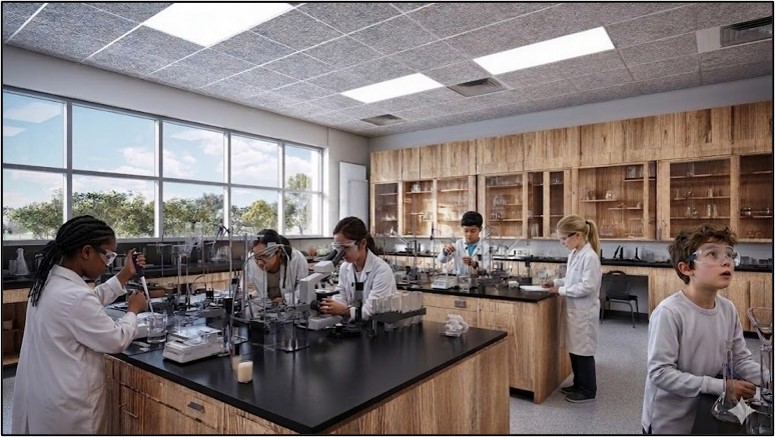
The STEM lab that appears in the brochure is gorgeous. Clean countertops. Storage bins neatly lined up on shelves, color organized. An array of new 3D printers lit up by LED strips. Motivational posters on the walls. Not a single pupil in sight.
The workaday STEM lab looks nothing like that.
It has half-finished projects on three separate tables. A bin full of wires someone neglected to sort. Whiteboard scribbles still on for the next period no one erased because the following class wants to continue building off of the same conversation. There’s a faint scent of hot glue. Somewhere, an engine is running and no one knows which party left it on.
That lab is doing its job. The brochure lab? Probably isn’t.
The Research Is Pretty Clear
Keeping track of the 3,766 students across 153 classrooms in 27 schools was a study led by Professor Peter Barrett at the University of Salford, which appeared in Building and Environment in 2015. The question was straightforward: Does the physical design of a classroom truly impact how much students learn? The answer was yes. Measurably yes.
There was a 16 percent variation accounted for by seven design features: natural light, temperature, air quality, flexibility, ownership, complexity and color. That’s a big number for something that most school planners hardly consider. The difference in impact of moving an average student from the worst-designed classroom to the best-designed classroom was about 1.3 sub-levels of progress. In a system in which students often progress by about two sub-levels each year, that’s the difference between falling behind and getting ahead.
In a separate study, Steelcase Education partnered with Simon Fraser University and Grand Valley State University to compare traditional rows-and-columns classrooms to environments designed for active learning. The results were hard to ignore: Eighty-four percent of students reported moderate or exceptional engagement increases. Ninety-eight percent of faculty observed increased engagement from students. And every faculty member said the redesigned spaces enhanced students’ creative potential.
So the space matters. A lot. And most of the STEM labs are designed incorrectly.
The Expensive Equipment Mistake
That’s the most common mistake schools make when designing a STEM lab: they purchase the equipment before everything else.
A principal enthuses over a grant. The money arrives. Someone orders a laser cutter, two 3D printers, a CNC router, a robotics kits set and a soldering station. Everything shows up in boxes. The room fills with gear. The photo looks great.
Then reality sets in. Nobody trained the teachers. The curriculum hasn’t changed. Students attend the lab once a week for an assigned activity and then return to their regular classrooms. The laser cutter is supervised and has a three-week waitlist. The 3D printers each take four hours per print while the class is forty-five minutes.
MIT’s Edgerton Center, which produced one of the more detailed sets of K-12 Makerspace Design Guides published, explains that point blank: keep it simple and evolve over time. A makerspace will take two to three years before it becomes a learning asset that is used on a regular basis. Filling a room with tools on day one is far less advantageous than adding equipment as curriculum develops and teachers get comfortable.
Equipment doesn’t teach. Teachers teach. The equipment simply sits there until someone knows what to do with it.
Zones Beat Open Floor Plans
The best STEM labs are zoned, not thrown together as one giant open room. MIT’s guide suggests about 60 square feet per student, roughly 1,500 square feet for a class of 25. That’s roughly double what a standard classroom holds. And not every school has that sort of space. Even in smaller spaces, however, the zone idea works.
The zones serve different functions. There’s an unregulated fabrication space in which students freely work with safe tools like 3D printers, vinyl cutters, basic hand tools and materials. This is the largest zone, about 600 to 700 square feet. Then there’s an enclosed fabrication space for equipment that requires direct supervision: laser cutters, CNC machines, power tools. Separating these isn’t only about safety (though it is). It’s about balancing the freedom of the open zone for students with appropriate oversight in the restricted one.
Project storage gets its own zone. This matters more than most people realize. If students are unable to save half-finished projects between class periods, projects must either be completed in a single session or taken apart every time the bell rings. Neither is good for learning. Mobile shelving units, labeled bins and designated pickup areas keep multi-day projects from crumbling under the chaos of a school schedule.
Smith System, a designer of school furniture, advises breaking spaces into quiet, medium and noisy areas with strategically placed storage acting as sound blockers between them. That’s a tiny detail that has a huge impact when one group is brainstorming quietly and another is operating a drill press 10 feet away.
The Perk No One Includes in the Budget: Empty Space
Stanford’s d.school found something unexpected about creative spaces. The most productive aren’t stuffed to the walls with things. They have empty space. On purpose.
This flies in the face of every instinct of an administrator. Unused square footage seems like money wasted. Why leave that corner open when another station could fit there? So, why not cover that gap with a display case?
Because it is in empty space where thinking occurs.
Neuroscience research supports this. Everything you can see in a room is asking for a little piece of your attention from everyone there. Notably, the more clutter in a space, the more cognitive bandwidth it takes to just process the environment. Fewer things competing for attention means more mental bandwidth free for problem-solving.
MIT’s guide echoes this directly. Start with less. Add things as, and when, the needs of the program require. A STEM lab that appears half-empty on opening day isn’t a failure. It’s a laboratory with space to become what it truly must be.
Storage Is the Problem No One Wants to Fix
Ask any educator with a makerspace what their biggest headache is. It’s not the technology. It’s not the curriculum. It’s storage.
Projects in progress need a home between Tuesday’s class and Thursday’s class. Materials should be easily accessible, yet organized. Tools need to be visible so that students can see them, but more importantly put them back. Solutions have included just plain practicality, which rarely glitters. Keep small projects in labeled ziplock bags, in milk crates by teacher name. Mobile pegboard tool carts where students can see everything that’s available and they know exactly where it goes when they’re done. Set cleanup time, no less than five minutes at the end of every class, built into a lesson plan instead of as an afterthought.
The Lab That Gets Used
The best STEM lab is not the one with the most equipment or the prettiest design or a bigger budget. It’s the one that gets used. Every period. Every day. By students who feel safe enough to create, break and recreate things.
You don’t fall into that kind of space by accident. It’s a result of someone asking the teachers what they wanted. Because someone made space for the program to grow. Because someone remembered that a $200 pegboard cart might be more important than a $4,000 printer. And because someone realized that the most powerful design element in any learning space isn’t a technology product at all.
It’s an empty table. Waiting for a student’s idea.
WHAT EFFECTIVE STEM LABS SHARE
→ Zone-based layouts that divide quiet, active and supervised work spaces
→ Work-in-progress storage that withstands the chaos of a school week
→ Deliberate whitespace that helps ideas evolve over time
THE BOTTOM LINE
The most powerful design element in any learning space is not technology. It is an empty table waiting for a student’s idea.
Mentis Sciences knows that the next generation of aerospace engineers, materials scientists, and defense innovators begin in spaces where curiosity is allowed to grow. The problems that matter demand people who were taught to think, not follow directions. www.mentissciences.com
