

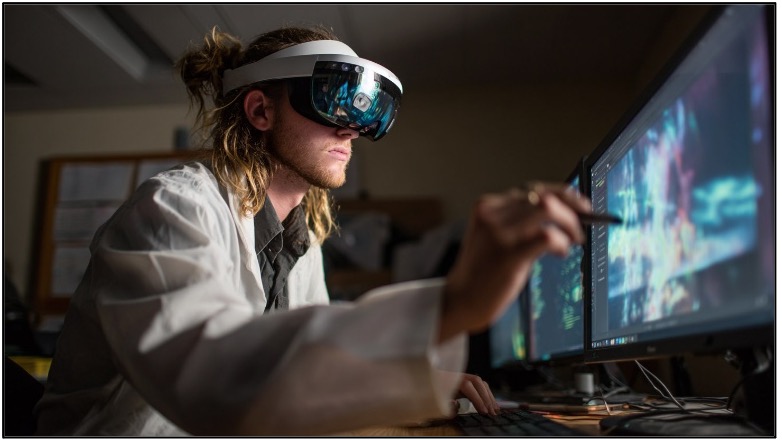
You stroll into a high school science lab in 2026 and what are you seeing? The same stuff your parents saw. Bunsen burners that with clogged nozzles and worn O-rings. Flasks and beakers someone chipped in 2014. A fume hood that haunts us with its untraceable noise. That periodic table poster — you know the one — peeling off the wall like it's making a break for it.
At the same time, at the opposite end of a spectrum, a kid runs a gene sequencing experiment on his laptop. From a bedroom. At 11pm. In pajamas, probably.
That's the gap. And it's getting weird.
The A.I. Thing (It's Not What You Think)
So there's this tutor. His name is Rex. He's not a he at all — just software — but here's the thing: Rex is a better listener than most people.
Picture a classroom. Thirty kids. One teacher trying their damnedest. Someone in the back is stuck. Somebody else wrapped up ten minutes ago and began sketching robots in their notebook. The teacher catches maybe... what? A third of what's happening? Half on a good day?
Rex watches everyone. All the time. Not creepy surveillance stuff—helpful stuff. Do you spend too much time forming a hypothesis? Rex notices. Skipped a step or two because you are impatient? Nudge. Heading entirely down the wrong path? Gentle redirect.
Some schools that use this stuff report that nearly 70 percent of students are meeting state science standards. Which... I mean. That's a lot. It’s a whole lot more than before.
You Can Feel It Now (Weird But True)
This sounds made up. It's not.
Haptic feedback. Gloves that push back. Controllers that fight back when you're pulling apart a molecular bond in a simulation. Your hands receive the science.
And here's the thing—it works. Like, really works. Students who embody concepts physically remember them SO much better. We're talking about 60 percent better retention in certain studies. Which makes sense, when you think about it. Your brain believes your hands.
The tech's still expensive for now. But friction, viscosity, electromagnetic fields — you know, stuff that's basically impossible to imagine? Suddenly you can feel it and it changes everything.
The Money Thing (It's the Big One)
What a teacher named Emily Dehoff said, which I remember, hit me this way. She teaches biochemistry. Her school doesn't have much. She said — and I'm paraphrasing here — that she can't really do the kind of microbiology lab work that virtual platforms can. She doesn't have the equipment. Nobody handed her a hundred thousand dollars for an electron microscope.
But her students? They're sequencing DNA. Conducting experiments that used to be the purview of university-caliber equipment. From regular computers.
And they can mess up. Repeatedly. No wasted chemicals. No broken glassware. No angry budget meetings.
For a rural school in the middle of nowhere? Or an overcrowded district where everything's being held together by optimism and duct tape? This isn't incremental improvement. It's a whole different game.
Blow It Up. See What Happens.
Real labs have rules. Obviously. Acids burn. Glass breaks. Mistakes have consequences. Sometimes the consequences include the school nurse.
Virtual labs? Mix the wrong chemicals. Watch the explosion. Learn something. Try again.
This sounds small. It's not small.
The fear of screwing up is the greatest killer of learning. Students, when they know that failure costs nothing, get curious. They venture dumb risks that happen to be smart. They ask the embarrassing question. They try the thing that most likely won't work.
That's actual science. Hypotheses fail constantly. That's the way it's supposed to go.
Midnight Chemistry Is Officially a Thing
The pandemic forced us to learn something schools should have known long ago: Not every brain functions between the hours of 8am and 3pm. Night people are a thing. Some people need to pause, think, come back later.
You don't need to worry about what time it is in the cloud lab. Labster alone has 300-odd simulations — in biology, chemistry, physics... You want it? It runs when you want. Pause mid-experiment. Pick it up tomorrow. Work at 2 a.m., if that's when your brain is cooperating.
For students with jobs? Family stuff? Health concerns that make showing up difficult? This isn't just a convenience; it's the difference between remaining in science and quitting.
So What Now?
Look. We’re not suggesting that virtual labs are a substitute for the real thing. There's something about having a beaker. Smelling sulfur. Seeing a reaction occur right before your very eyes. That matters. That's part of it.
But the schools that do figure this out? They won't choose. They'll do both. Virtual for practice, repetition, pricey equipment, dangerous stuff. Physical for the moments you feel like science is real.
The issue isn't whether it works. That's been answered.
Only question is whether anyone's listening.
Mentis Sciences sits at the confluence of advanced materials, aerospace and academia. We're the kind of people who believe this stuff makes a difference. www.mentissciences.com
