

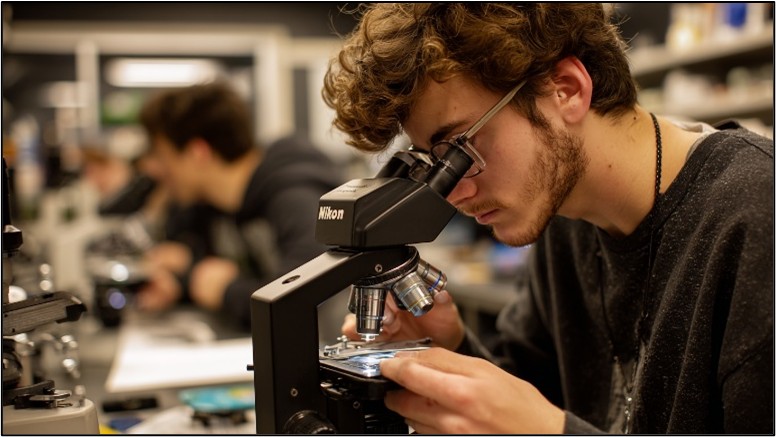
There's this moment that happens in STEM education.
A student stops seeing tools as things the teacher makes us use and starts seeing them as things that let me build what I'm imagining. In that moment, the tools switch from being an obstacle in the way to being something I can use to get to where I want to go.
And honestly? The quality of tools matters much more than people want to admit.
The Tool Paradox
Did you know that for decades there was an assumption in the design of educational STEM tools that students needed "simplified" versions of the professional gear: dumbed-down microscopes, toy-ish circuit builders, software with training wheels that never came off.
The thinking was protective. Thoughtful, even. Do not overload students with more than they can handle.
Educators and engineers have taken another turn. They have started asking: Are we underestimating them (students)? What if making things simple creates a wall between the classroom and the real world?
And that question led to something remarkable.
When Educational Tools Become Professional Tools
Modern STEM tools are more frequently adopting this interesting dual purpose philosophy. They are sophisticated enough to allow real scientists to perform tasks with them, but also accessible enough for students who still have areas of their understanding that are under construction.
For example, modern day educational purpose oscilloscopes. They're not pretend oscilloscopes. They are real instruments that can take measurements that would have required professional equipment costing thousands of dollars a generation ago. However, they offer interface designs that make learning easy. There are also built-in tutorials that activate as needed, and connectivity that lets students share findings and collaborate as the need arises.
Alternatively, 3D printers in schools aren't toys. They are genuine tools that teach use of CAD software and could also potentially teach properties of materials, iterative design troubleshooting, and manufacturing constraints. Students are not playing at engineering — they're doing real engineering, at a scale for learning.
The transformation happens when tools:
• Offer professional features using user-friendly interfaces.
• Let people try new things.
• Maintain industry connections.
• Make it easier for the student if needed.
• Help us to create, not just observe.
The Maker Movement's Hidden Contribution
The maker movement's impact on educational STEM tools has been quietly revolutionary.
It made us believe that we learn technical skills by building real things. Not watching demonstrations. Not filling out worksheets. Not listening to lectures about how things work in theory.
Building. Testing. Failing. Iterating. Building again better.
Tools that complement this philosophy best are those that do not hamper your progress while also providing instruction in the proper methodology. Like Arduino ecosystems which are simple enough for beginners but powerful enough that experts use them for rapid prototyping. Or laser cutters that can safely be used in educational settings while having the precision required to create real-life fabrication projects.
There's a lovely moment when a student realizes the tool they learned on at school is just the same as what the professionals use—albeit with perhaps a few more advanced features that they don't need yet. It is powerful to realize that you are not rehearsing for later but doing real work now.
Measurement Tools That Teach Precision
Let's talk about something specific: measurement tools in STEM education.
Traditional approach? Provide students with calibrated instruments for data recording. This is acceptable to teach them about collecting data. However, it misses a vital point. That is, they are not taught how measurement is also a skill. It involves understanding uncertainty, calibration, systematic error versus random error, and that environmental conditions can affect measurements.
Modern measurement instruments used in education increasingly include features that allow these notions to become real. Digital calipers that show measurement uncertainty. A multimeter that explains your selected settings. Data loggers assisting learners with sampling rates and resolution concepts.
The instruments end up as teaching tools that help build intuition about what measurement means—not simply registering numbers, but rather what those numbers really mean and what they don't.
Software Tools That Mirror Professional Workflows
Let's move to the really fun thing: the software tools.
For many years, educational software was a category of its own. Educational software was built for education and often didn't resemble the professional stuff at all. This meant students had to basically unlearn everything when they entered industry.
That's changing dramatically.
An increasing number of educational institutions are adopting true professional programs through academic licensing or using educational platforms that are purposely designed to integrate easily with their professional counterparts. MATLAB in engineering. Python for data science. Fusion 360 for CAD. KiCad or Eagle for circuit design.
Students aren't learning "educational versions" – they're learning the real thing (with appropriate scaffolding and curriculum). As a result, when they take on internships or entry-level roles, they are already fluent in the software systems their colleagues use.
The Lab Equipment Evolution
The educational lab equipment of today is really awesome.
Cloud-connected spectrophotometers enable students to compare results between classrooms and even schools. Robotics kits that teach sensor integration, control theory, and mechanical design, not just programming. Bioreactors designed for educational use which use the same principles as scaled-up systems.
The cost curves are favorable, which makes this even more exciting. As more institutions become able to invest in things that required massive capital investment only a generation ago, more students are able to gain experience with sophisticated tools.
It is clear not all schools can afford cutting-edge technology. The trend is good: our instruments are not becoming simply more powerful, but also cheaper, and that is precisely the combination that expands opportunity.
The Digital-Physical Integration
One of the most interesting developments is how modern STEM tools now effortlessly combine digital and physical learning.
You may first design something in CAD software. From there, you might simulate it to see how it behaves in the real world. Then you may fabricate it on a CNC mill or a 3D printer. Then you may take measurements with digital devices to see how it performs. Finally, you may alter your design based on real-life performance. You may do all of this in one project. Also, the tools will talk to each other naturally.
This integration reflects the way professional engineering works. Design doesn't happen in isolation from fabrication. Testing informs simulation. Digital models need validation against physical reality.
Students learn this integrated workflow naturally because these tools are united, not as an abstract concept.
Career Foundations Through Authentic Tools
As students learn with instruments similar to those utilized by professionals in their fields, something important happens. The objective is no longer simply teaching technical skills. Instead, they assimilate professional methods, develop professional workflows, and gain confidence in the knowledge that what they are learning can be immediately and directly applied. Moreover, this is the most important aspect of the equipment they learn with.
The tools themselves act as a bridge between educational and professional contexts. There is not a gap that students will cross later; they are already on a continuum.
This transformation of seeing tools as not just educational aids but instead professional capabilities you're actively developing creates career-ready STEM graduates who are hired already fluent in how things actually get done.
Mentis Sciences' philosophy of the tools-as-enablers concept is key to its approach to STEM education and advanced technology. The tools they offer grow with the learner and aren't simulated but real, authentic, capable tools. They offer these tools in recognition of the fact that the best pedagogy is professional practice, just scaled appropriately. Discover their approach at www.mentissciences.com—because the right tools don't just teach skills, they build careers.
