

Labs at universities had been quiet places. Heavy doors. Perhaps the door had some kind of little window. Inside was a professor, and a few grad students doing things nobody outside the walls understood and most of them were fine with it that way.
That lab is gone.
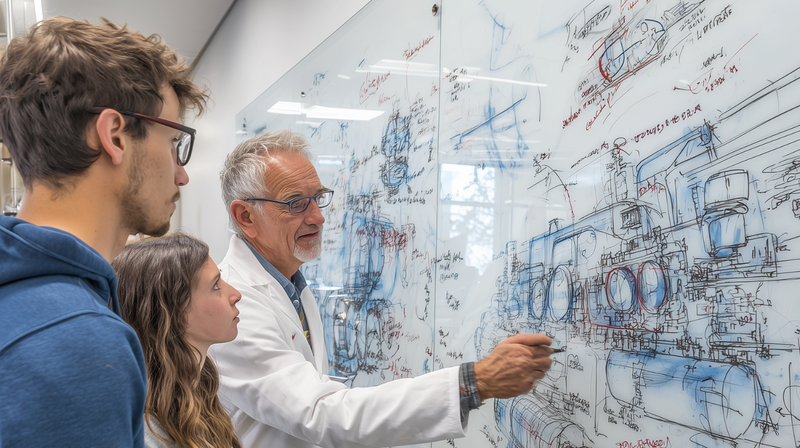
Now walk into a live university lab and you will see a different picture altogether. Defense contractor senior engineer maybe at a whiteboard with a grad student. Two undergrads at work in the corner with a test rig. A post-doc via video call with some guy at NASA. The professor is in the building somewhere, though no one seems to know where and no one appears to care. The door is held open with a pile of textbooks; too many people go through it.
The walls came down. Nobody put them back up.
Most of the 20th century saw the two communities largely ignore each other on the part of universities and industry. Companies conducted their own in-house R&D. Universities did theirs. Every so often, a paper would get published, an industry researcher would read it and some useful stuff eventually transitioned over. The whole process took years. Sometimes decades.
It worked when everyone was in no hurry. Nobody is there anymore.
There is rarely a hard line between basic research and applied knowledge in real-world engineering problems. Not just a chemistry problem: A new heat-resistant composite that's also a question of manufacturing. A testing question. A cost question. A supply chain question. And a question of whether the actual users want it. And no lab has them all. Thus, the answers are assembled by people who are willing to share answers across institutions in real time.
The numbers quite simply tell the tale. According to the National Science Foundation, U.S. universities performed approximately $108 billion of research and development in fiscal 2022 alone. About $7 billion of that was straight from your company funding. Over the last 20 years that share has more than doubled. And the dollar amount misses the bigger point; what about the value of discussions, shared facilities, co-hires, and students walking between these two worlds without a second thought?
Some universities and industry got this right; if there was a textbook example of it, it is MIT. Established in 1948, the Industrial Liaison Program works with approximately 230 member companies today. Organized access to research, students and faculty. Now that is not a small operation. It forms a lasting bridge between an engineering school and the international industrial sphere.
In the lab, on the other hand, there's a less formal and more useful story. Consider CSAIL, the Computer Science and Artificial Intelligence Lab. The MIT campus has the largest lab of its kind. Over 1500 researchers from over 50 research groups. The companies are not merely there as sponsors. They embed people. Engineers who work in the industry at major companies tacitly sit next to graduate students and postdocs tackling those same issues with comparable tools. Information flows at the speed of a conversation, not a quarterly journal, when someone solves a piece of it.
Stanford has created a similar system around its engineering school, and the wider research enterprise drew in more than $1.97 billion in sponsored research funding for fiscal year 2023. With the same theme, Carnegie Mellon, Georgia Tech, Michigan and a dozen more built their own unique flavors of this model, which has become so entrenched that any elite engineering school without one is an exception.
This is where most people mess up: the companies are not purchasing research. They are buying access. Access to people who think differently, access to facilities they could not afford to mirror that they are putting the resources in, and access to students that understand the problem even before the job interview. The universities have not been compromised. Often, they are just getting better at the work because their researchers have been talking to people who actually have to make it work in the wild.
Put aside those formal arrangements for now. Observe the daily happenings. An engineer at an aerospace firm who is tasked to a collaboration with a materials lab at a university. She is not a guest lecturer. She is not on a committee. She has a desk. She has a badge. And a problem that neither she nor her company was able to fix fast enough by themselves.
In the first week, she keeps her mouth shut. Grad students guide her through testing equipment not owned by her company. And then the professor explains why a particular failure mode keeps appearing in the data, and what that may actually mean. The engineer discovers that a thing her team has regarded as a manufacturing defect for two years is in fact just an inherent property of the material nobody took the time to actually characterize.
Month three, she is running joint experiments with two grad students. At month six: a publication from the lab; a pending patent application filed by the company; one PhD student (with two years to go) has already received an offer from that company which did not exist, as such, at the time of partnership. And none of this was in the original deal. It just happened. That's because the right people sat in a room long enough for ideas to mix.
This is what success looks like when it comes to these partnerships. Not a press release. Not a logo on a website. Just people with different training and different incentives sitting at the same table, quarrelling over what the data says.
None of this happened by chance. The legal structure that made it all possible actually predates most of us!
In 1980, Congress passed the Bayh-Dole Act that allowed universities to own patents resulting from federally funded research and license those patents to companies. One law completely changed the relationship between American colleges and universities with American industry. The number of U.S. universities that have been awarded patents is now in excess of 100,000 and the foundation of over 17,000 startups based on university research. since the law was signed into effect.
That's just the administrative boring version. The interesting part is that suddenly, for the first time, universities had an extraordinary financial vested interest in whether their research actually mattered to anyone outside of the academic journal system. Tech transfer offices appeared. Partnerships with industry ceased to be suspicious. The initial response from faculty centered on how they could think about applications without it feeling like a break in their academic vows.
Federal funding kept growing too. Manufacturing USA is a network of 17 national institutes established by the government in 2014. Each is an intentional combination of universities, companies, and government labs focused on a particular aspect of advanced manufacturing. The Advanced Functional Fabrics of America institute based at MIT includes a consortium of over 150 partners. This effort follows a similar initiative done since 2015 by University of Tennessee-based Institute for Advanced Composites Manufacturing Innovation (IACMI) specializing in fiber-reinforced polymer composites.
These institutes are not researching in the classical sense. The idea is to take research that already exists and find a way to actually do it. Open lab work like that simply would not be possible in the closed-door operations of most universities.
Something most parents touring engineering schools miss: Students in these collaborative labs learn a discipline where the education looks nothing like that of their professors.
They are not learning theory and then going on to take a course in applications. They are working with industry engineers starting from their 2nd or 3rd year. They watch as real companies make decisions. They watch adults from outside academia arguing about technical issues and resolving those disagreements with data, not opinions. They end up with a portfolio including both peer-reviewed publications and real product contributions before they graduate.
The hiring market noticed. The result: Companies that partner with university labs find their work for graduates of those programs gets wrapped up in less time. The students arrive knowing how the company operates and what kind of gear it uses and what problems it really cares about. The student-to-professional transition that used to take a couple of years now takes only a few months.
Graduate school looks different too. Over the relatively short time period of 15 years, funding for industry fellowships has significantly increased, and many students working towards their PhDs are seriously embedded within these corporate research labs as they train. They have deliberately blurred the line between student and professional. The blur was deemed valuable by both sides.
One of the most impactful university-industry partnerships take place in defense and aerospace. In part because the problems are tough. Partly because the problems matter.
The Department of Defense University Research Initiative supports basic research at universities dedicated to solving national security challenges. Through that program, the Multidisciplinary University Research Initiative announced about $220 million in 2024 for 31 new research efforts. The Air Force, Army, Navy and DARPA all have their respective programs based on that same concept. The thing that brought them here: None of these programs will work unless there are university labs ready to tackle the industry-relevant problems in addition to basic research.
This plays out with a clean example in composites work. How do fibers behave within a polymer matrix at high temperatures? A university lab studies this. An industry partner requires that information to make a part that must live in a jet engine for 10,000 hours. A defense agency requires this part for a certain platform by some date. None of those three players can do the heavy lifting by themselves. Combining with each other, they can accomplish something that in the old system would take twice as long. And, no, it is not uncommon for the same student to engage all three before graduation.
Mentis Sciences watches this sort of collaboration closely. Advanced composites, hypersonic materials and defense engineering problems are not solved by any one institution. And the materials that fare best in some of the most brutal conditions require a village willing to share knowledge. Touching on that community is a big part of our universities. Not because somebody mandated it. Because the work is too hard to work any other way.
Go to any major engineering school nowadays and all of this will be on display for you. Corporate sponsor names on lab doors; departmental websites on industry advisory boards. Email addresses of grad students from two organizations. You come to career fairs where recruiters recognize students by name for having worked with them for a year on research projects.
None of this is publicity. That is simply the nature of how work occurs today.
Gone are the days of the university lab as a walled-off academic cloister. What it has been replaced with is a lot more messy, difficult to manage and way more useful. Professors are still conducting basic research. Students are still earning degrees. But the work is happening in concert with the rest of world, and the rest of world has shown up to join. The doorway stays open with a pile of textbooks. They are in no great rush to move them.
The wall between universities and industry came down. It is harder work, those conversations are noisier and the results are better than anything the old model could deliver.
Mentis Sciences works at the intersection of advanced composites, aerospace materials applied to hypersonic engineering and defense technology. Many of these challenges are some of the toughest in the field, and they don't often fall to one institution because the people who solve them know how to move across the lines that used to make research separate from reality.
