

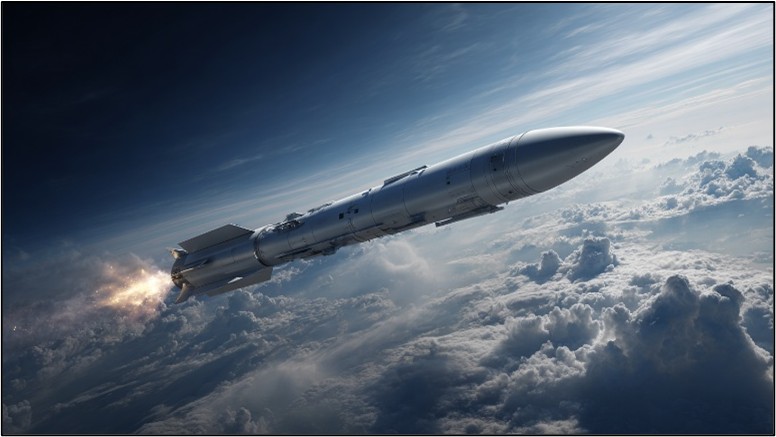
Here's a challenge in materials engineering so steeped in science fiction it even sounds made up.
Design a substance that shields delicate electrical circuits when traveling at five times the speed of sound. The surface temperature exceeds the melting point of aluminum. Further, the pressure waves result in forces sufficient to crush ordinary structures. Plus, any electromagnetic interference means mission failure.
Oh, and it needs to be invisible to radio waves.
Welcome to hypersonic radome materials. The laws of physics are not merely suggestions. They are strict constraints to be engineered around with meticulous precision.
What "Hypersonic" Actually Means
To give you some context, hypersonic flight is defined as Mach 5 and above. This is five times the speed of sound (around one mile per second at sea level).
At these velocities, things get weird. Really weird.
The air molecules get compressed at the leading surfaces because the molecules can't get out of the way quickly enough. This creates shock waves and heat from compression. We're talking temperatures that can exceed thousands of degrees – so hot that it will melt most metals. So hot that it will vaporize some materials. So hot that "overheating" is putting it mildly.
A radome covers radar and communications antennas, and it must be strong enough to endure the environment while being transparent to electromagnetic signals. This component won't obstruct or distort the radio waves that the antenna needs to send or receive. Additionally, it won't create any electromagnetic interference. Also, it won't fail structurally from the combined heat and pressure.
Casual materials engineering challenge, right?
The Multi-Physics Problem
Hypersonic radome materials are so interesting from an engineering perspective because you are simultaneously addressing multiple physics problems which interact with each other.
Thermal management: The material must withstand extreme temperatures. It will have some sort of active cooling or ablative protection that will gradually sacrifice itself, and the choice matters for everything else.
Structural integrity: To withstand the onslaught of aerodynamic pressures and vibrations that would rattle ordinary structures to pieces, the material must be strong at operating temperatures.
Electromagnetic transparency: The material must have the ability to permit radio waves to pass through with minimum attenuation or phase distortion. This requires careful control of its dielectric properties, thickness of the material, internal structure, etc.
Environmental stability: High temperatures combined with dissociated oxygen and nitrogen from the shock-heated air promote oxidation, chemical reactions with atmospheric species and UV degradation.
And these requirements often conflict with each other. Materials that are good at thermal management may be poor in electromagnetic properties. Structural solutions might interfere with RF transparency. There are compromises behind every design decision.
Advanced Ceramic Systems
Modern hypersonic radome materials are based on advanced ceramic systems – silicon nitride, boron nitride or specialized quartz composites. They offer this combination of properties engineered at the molecular level.
Ceramics offer inherent high-temperature stability. They do not melt and they do not significantly degrade in oxidizing environments at temperatures that would destroy metals or polymers. We can design specific ceramic formulations to have dielectric properties optimized for RF transparency.
However, ceramics are also brittle, which poses problems for withstanding mechanical loads and thermal shock. The engineering innovation is developing ceramic systems that maintain their temperature resistance capabilities while having sufficient toughness to survive the operational environment.
Recent advances include:
• Novel fiber-reinforced ceramic composites that combine ceramic thermal resistance with fibrous toughness.
• Controlled porosity that reduces thermal conductivity while maintaining strength.
• Multi-layer ceramic structures made up of different layers that are optimized for different functions.
• Protective coatings that improve oxidation resistance and minimize catalytic heating effects.
Active Cooling Integration
For the most demanding applications, passive material resistance might not be enough, requiring active thermal management integrated into the radome.
Things become complex when you add systems to an already challenging design. Cooling channels must be added without seriously affecting electromagnetic performance. The coolant must not lose its effectiveness in the temperature range encountered. Pump systems must be reliable and lightweight.
But when active cooling systems do work, they greatly expand the performance envelope to enable sustained hypersonic flight durations that would otherwise be impossible with only passive systems.
Ablative Materials Approaches
There's another philosophy: deliberately sacrificing material through controlled ablation.
Ablative materials absorb heat through phase change and mass loss as the material erodes away, preventing heat from reaching the substrate. You're not expecting the material to have infinite life. Instead, you're designing exactly how it will degrade to ensure protection and performance throughout the mission duration.
For some applications, particularly shorter duration missions, this approach has the advantages of higher peak temperature capability and system simplicity. The engineering challenge is to make sure that the ablation occurs as planned, the electromagnetic properties stay acceptable as the material erodes and the rates of erosion are well understood under different flight conditions.
The Testing Challenge
A somewhat neglected issue: testing hypersonic radome materials is almost as difficult as their design.
You require facilities that can recreate the combined thermal, mechanical and chemical environment of hypersonic flight. Facilities capable of producing high-enthalpy conditions. Wind tunnels capable of sustained hypersonic flows. Thermal cycling chambers that can reach these temperature ranges. RF testing that can characterize electromagnetic performance under these conditions.
The testing capabilities to generate these conditions are costly and rare. This means that most material development efforts take place within iterative loops of design, limited testing, computational modeling to provide insight or fill gaps in test data, refined design and more testing. Making this efficient takes experience and sophisticated simulation capability.
Computational Materials Design
The modern development of hypersonic radome materials relies heavily on computational approaches which can predict material behavior before costly testing.
Molecular dynamics simulations to model ceramics at extreme temperatures. Finite element analysis predicting thermal and stress distributions. Electromagnetic modeling that evaluates RF performance. Multi-physics simulations that model thermal, structural and electromagnetic interactions.
This computational work does not replace physical validation; it is always needed. However, it dramatically reduces the design space. Further, it enables experimentalists to focus on the most promising candidates, making testing less expensive.
Manufacturing Considerations
Even with an optimal material design, you still need to manufacture the radome itself, a whole separate engineering problem.
Producing ceramic components consistently and with the right properties. Incorporating fiber reinforcement with specific orientations. Achieving required tolerances on complex geometries. Ensuring consistent quality across production runs. Creating non-destructive inspection methods that can validate internal structures.
The manufacturing processes for these components often make use of specialized techniques, for example, chemical vapor deposition, hot isostatic pressing, precision machining with diamond tools, layer-by-layer additive approaches, etc. These processes not only enable performance that was very difficult with conventional processing, but also improve the ability to control material properties.
Multi-Spectral Considerations
Increasingly, hypersonic radomes must be transparent to a range of frequencies – as opposed to a single radio frequency – and to multiple types of sensors.
Creating materials that allow radio-frequency signals to pass through while still enabling optical or infrared sensors to work adds another layer of complexity. Different wavelengths behave differently when traveling through materials. For example, a material can be transparent to microwave frequencies but opaque to infrared frequencies, or vice versa.
This requires careful material selection. We can use multi-layer structures where one layer is optimized for one spectrum range while a different layer handles other ranges. Modeling has to be sophisticated enough for all specifications to be satisfied simultaneously.
The Future Frontier
This convergence of materials science, computational design, advanced manufacturing, and systems integration appears to be expanding the horizons of possibility for hypersonic flight.
Missions able to withstand more extreme conditions due to longer duration and higher speed. Radomes that maintain optimal performance over wider operating ranges. Lighter weight solutions that improve system efficiency. Manufacturing methods that reduce costs so more applications become viable.
The laws of physics have not changed. Thermodynamics is still in play, and electromagnetic theory still governs the behavior of radio frequency (RF) signals. What is changing, however, is our ability to engineer materials that work well under those constraints.
This is thanks to innovations in materials chemistry, structural design, processing techniques, and systems integration.
Organizations like Mentis Sciences bring technical capabilities to advanced aerospace challenges in this pursuit of materials engineering excellence at the extremes of physics. Their work spans topics from materials development to integrated system solutions. Consequently, they employ deep technical expertise and innovative approaches to solve the most complex engineering problems. Discover their capabilities at www.mentissciences.com—because advancing hypersonic technologies requires materials that don't just survive extreme conditions, they enable entirely new operational possibilities.
